In part 1, I write the first couple of days of my two-week solo(ish) backpacking trip through Mumbai, Varanasi, and New Delhi.
__
A Brief Overview of Mussoorie: The Queen of The Hills
Mussoorie hill station resides in the Dehradun district of the Indian state of Uttarakhand. Overwhelmingly scenic with a lively social scene, it’s the perfect summer getaway…especially if you’re in search of some respite from the heat.
Never Have I Ever…Been Pantsed By A Monkey (Well…Almost!)
After only one full day in New Delhi, I was headed to the bus station to begin my overnight journey to Mussoorie, Uttarakhand.
To this day, even after successfully navigating the buses several times throughout my time in India, I remain mystified by the system.
My bus from New Delhi to Mussoorie was scheduled to leave by 11:15PM. (Note: Before booking this trip, I did have a couple of reservations towards traveling at night and/or through the night solo. However, I actually booked this leg of the trip through a travel agency called India Someday. They are specifically known for creating itineraries for solo female travelers through India but Hannah, Carly, and I actually used them when we did our travel through Jaipur and Agra. I opted to do this again because they have great accommodation recommendations and offer 24/7 communication. It definitely put me more at ease as a solo traveler (and my parents too)).
I got to my bus stand really early which was a bad idea for several reasons. Not only was it still really humid, but standing at the bus stand that late was a little unsettling. And having so much time between getting there and my bus arriving, I had a lot of time to overthink whether or not I was in the right place. A lot of the time, the locations of bus stands are quite vague. This bus ticket just gave the area and said “across from the jewelry shop.” After pacing for a while, I asked a girl who was sitting near me if she could confirm that I was in the right spot. After reassuring me and even calling the bus conductor for an updated ETA when it was a little late, I was good to go!
Once my bus arrived, I was able to sleep a bit before I decided it wasn’t going to be quality sleep. About an hour before my stop, the bus pulled off the road and everyone got out. I initially thought that we had just gotten to a rest stop (they do this a couple of times throughout the trip) but once I realized everyone had gotten off with their bags and luggage, I decided I probably needed to get off too. About five minutes later, another bus pulled up and everyone got on. This prompted me to ask the driver what was going on and he simply just said “get in”. Hm. Turns out we were just switching to a smaller bus because the rest of the ride was going up the narrow, bendy mountain roads. I spent the next hour in the back of the bus trying not to puke.
Hopping off the bus at my stop, I realized just how beautiful the weather and the view was. In the middle of the mountains, it was nice and cool.
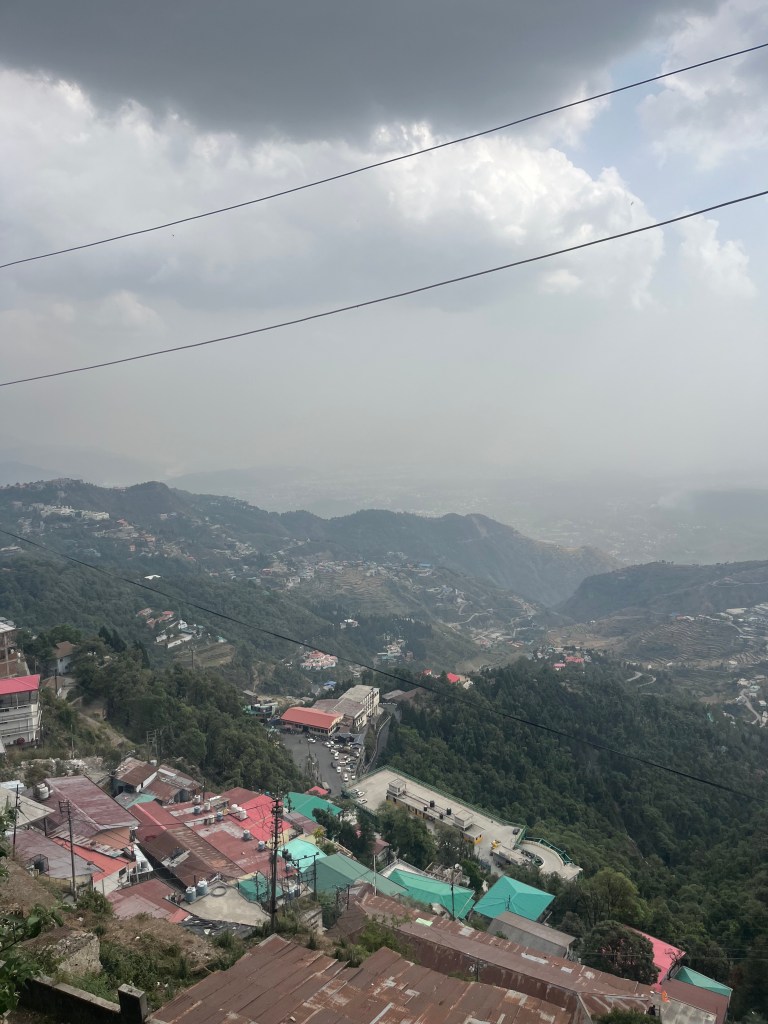
View of the mountains from my hostel
After a quick (and much needed) rest in my hostel dorm, I made my way to breakfast before starting my mountain adventures.
A relaxing first day, I took advantage of the nice weather and did a ton of walking. Mall Road, known most for its markets and cafes, is where I spent most of this day. I was just so happy to be outside in a climate that was neither extreme heat or intense rain that I didn’t need much entertainment otherwise.
The next morning, I woke up early to get a head start on sight-seeing. My first stop was to Gun Hill, which was reachable by walking or cable car. Since it looked amusing (though a bit sketchy) I decided to take the cable car up. On a clear day, it’s possible to see the Himalayan Mountain range from its viewpoint. Though, I was a bit disappointed when I reached the top. With the crowd, it was difficult to get a good spot to view the mountains. Along with that, I found the area to be a bit overly commercialized. Plenty of shops and restaurants, but also arcades and games that I can only describe as similar to what you’d find at a carnival.
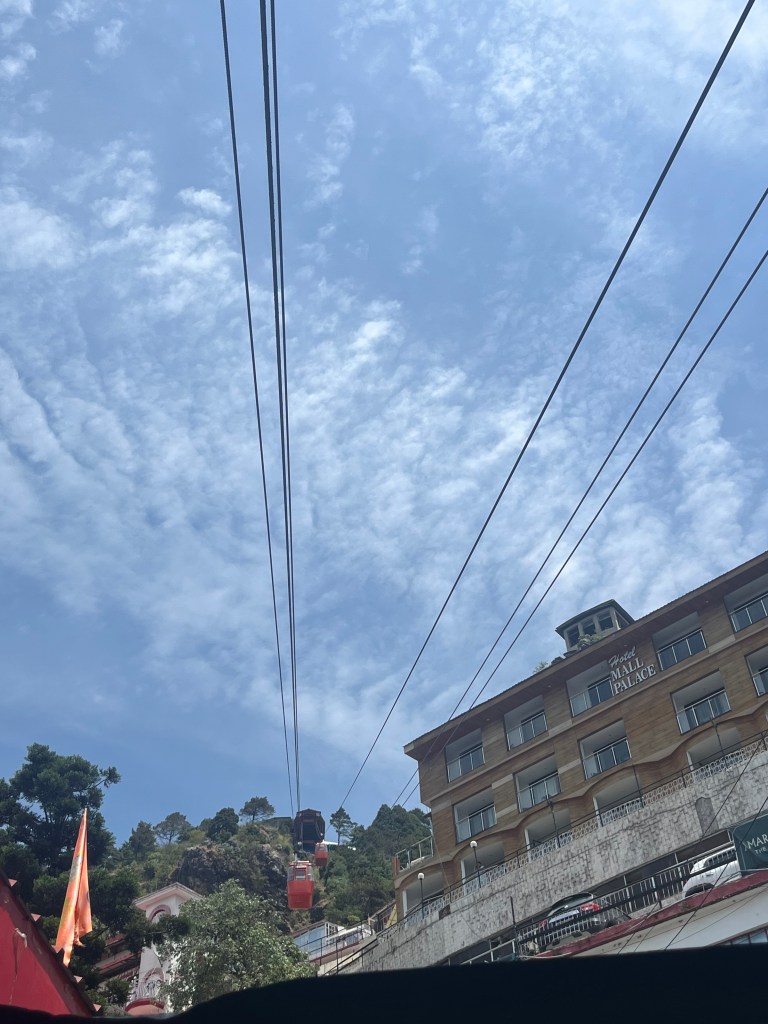
Cable cars going up to Gun Hill
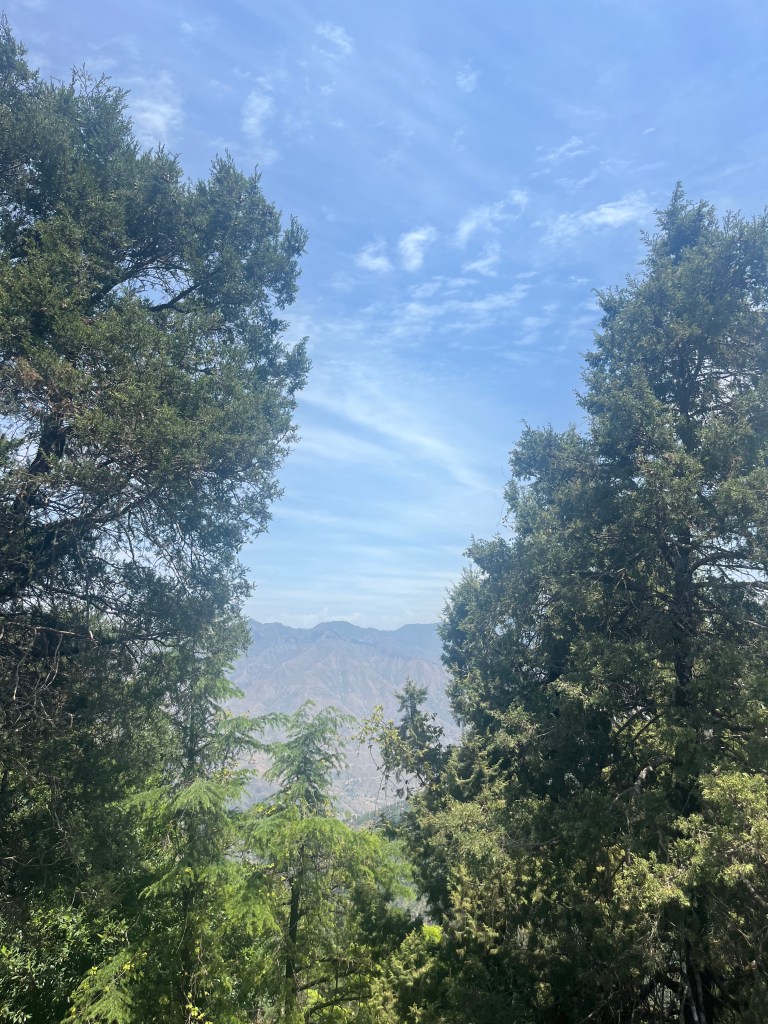
View from Gun Hill
Before my next stop, I grabbed some lunch (with a special guest!).

Fried Rice and a Bee
After seeing the second highest peak in Mussoorie and feeling a bit underwhelmed by the experience, I thought I’d make up for it by taking a small trek just before sunset to La Tibba, the highest peak!
The start of this journey was quite nice. I took a scenic walk through the neighborhood surrounded by mountains and lined with cafes, vintage shops, and houses (I even passed by Ruskin Bond’s house, a renowned Indian author!). Once I hit the actual wooded area of the trek, things started to go south for me…
Although the path was clear and easy to navigate, I realized quickly that this trek was rarely done on foot. Rather, people take scooters and cars up to the viewpoint. I didn’t fully understand why this was until I got about twenty minutes away from the top. A couple of feet in front of my path came two monkeys and, instead of attempting to pass them, I decided that I would wait for them to clear (we had an unnerving run-in with a monkey in Agra and I’ve been afraid of them ever since). While waiting, I turned my back against the guard rail and was now facing away from the woods. Unaware of my surroundings behind me, I suddenly felt the most aggressive tug on the back of my dress from a monkey. This prompted me to yell (loudly) and jump into the middle of the path just as a scooter was coming towards me. The driver (thankfully) swerved out of the way (allowing me to live another day) and shouted some profanities at me as he passed.
I remained standing in the middle of the path thinking did that really just happen before making an assessment in under thirty seconds that (in my opinion) saved me from further dancing with death. I looked up at the trees above me and noticed troops of monkeys in the branches. I came to the sudden realization that if I were to continue my journey, I would have to make the trek back after sunset with monkeys lurking in the darkness. Deeply unsettled by that thought, I made an immediate pivot back to the direction that I came from. I have lovingly named this story “That Time A Monkey Would Have Pantsed Me If I Wasn’t Wearing a Dress.”
Fast-walking away from the monkeys, I ended up at dinner with a comfort glass of wine. It’s been confirmed; when I am in a fight or flight situation, I will choose flight (seriously, don’t mess with monkeys anywhere).

View from (almost) the top of La Tibba
Me and My Oversized Backpack Vs. The World (AKA India’s Bus System…Again).
Out of all the days on this solo trip, my journey from Mussoorie to Rishikesh wins the title of most turbulent.
Similar to my ticket from New Delhi, my bus pick-up location in Mussoorie was quite vague: “library bus stand”. Unsurprisingly, when I asked the hostel worker the night before I was leaving if he could tell me where exactly this location was, he told me that there were two library bus stands. Though he assured me that in the morning he could call the conductor to get more information.
So, the next morning I packed my oversized backpack and headed to the reception to get confirmation. We spent over half an hour trying to call the bus conductor with no luck. I eventually called Aliyah, my contact from India Someday, only to learn she was having trouble reaching the conductor as well. Uh oh.
At this point, my bus was scheduled to arrive in about fifteen minutes and I still had no idea where I was supposed to go to get on it. One location was about a five minute walk from my hostel while the other would’ve taken me a half an hour to get to. I had accepted that I was just going to miss my bus. Finally Aliyah had called me and informed me that the bus had actually been canceled due to technical issues. Though annoyed, I was relieved that the issues had occurred prior to me boarding the bus and not after, ultimately leaving me stranded in an unfamiliar place (this is a situation where I could certainly imagine myself panicking).
Aliyah had also informed me that there was no other same-day bus available that would take me directly to Rishikesh. I had the option to get a driver to take me there but it would be an extra cost. Plus, that’s too easy! After discussing it with the hostel employee, he assured me that it would be a simple journey on the local buses.
Although this journey was not particularly challenging, I would have not chosen to describe it as simple. Walk to the bus stand. Take the bus. Take an auto rickshaw to another bus stand. Take the other bus. Take another auto rickshaw. You’re there! Sure, on paper this looks like a simple task. But I must gently (and lovingly) remind you where I am in the world: India. Nothing comes without a little bit of chaos here.
This day goes down in my own personal historical record as the day I decided I can pretty much navigate any situation ever (not without a little bit of stress, frustration, and impatience).
So, with these slightly-vague instructions in my notes app, I started the journey. I wish I had taken more pictures of this excursion.
My walk to the bus stand was quick, but did not lack its challenges. The building (I’m not sure I can even describe it as such) of where I needed to buy a ticket and wait for the bus was hiding in a curve of the bendy, narrow road. When I eventually located it, I stood in a line that should have only taken me, at most, a half an hour to get through; I was maybe ninth or tenth person in a very non-uniform line. Instead, I waited for a bus ticket for almost two hours. To this day, I genuinely cannot figure out what was going on in front of me, who/how many people were working and issuing tickets, or if I was ever going to make it out of there alive.
Eventually, and still with about four or five women in line ahead of me, a bus pulled up and the ticket guy hopped off and started mumbling something. I wasn’t paying attention to it until the woman behind me turned to me and said “You! You’re traveling alone…he has one single seat on that bus…Go!” And I did just that. With my oversized backpack (that had begun to weigh me down), I ran from the line and hopped onto the last empty seat. As I paid my 80 rupee fare I let out a sigh of relief.
This first ride from was from Mussoorie to the Dehradun railway station which was about 50 minutes. Once I got off the bus there, I caught my auto rickshaw to the Dehradun bus stand. Unsurprisingly, these autos between bus stands were what cost me the most. It’s hard to know what the baseline price is from city to city and I’m pretty much always charged a “foreigner tax” which I’m usually fine with (emphasis: usually. We’ll get to this soon).
My auto driver dropped me off at the bus stand here and it was, by far, the most chaotic one I had seen. It was just a section under an overpass, with no signage, that buses would quickly stop at and yell out their location. I walked up and down the side of the road that was lined with several buses, carefully listening to the places the drivers were yelling out, before one pulled up and yelled “Rishikesh!”. I hopped on. This 40 minute ride cost me 50 rupees.
By the time that my bus pulled into the station in Rishikesh, I was beginning to lose my energy quickly. Just one more auto. This should have been the least complicated part.
The auto rickshaws in Rishikesh were shared, so if you were going to the same place as a few other people, you’ll all pile into one and it should be cheaper. When I finally found a driver that would take me to Tapovan and asked for 300 rupees, I agreed even though I knew he was asking for way too much.
I sat down in the rickshaw with a mother and her daughter who was about eight years old. The driver was eating, socializing, and calling over other drivers to show them the American in his rickshaw. I was patient about this at first but the longer it was taking the more irritated I became.
We were still waiting five minutes later when he came over to me again and asked for 500 rupees instead of 300. I vehemently denied his request. When he walked away to resume his conversation with the other drivers, the woman in the auto with me told me that she was paying only 200 for both herself and her daughter. And that’s when my irritation increased tenfold.
I grabbed my oversized backpack and began to step out of the auto when the driver saw me and told me to get back in, assuring me that we’d be on our way in another five minutes. “Dude, take me now. Stop socializing, finish eating, and take me right now. Otherwise I’m finding another way.” This is not necessarily my proudest moment of this trip and my impatience certainly got the best of me in this situation. But still, he had it coming.
He finally got going and once we were on our way, I apologized to the mother daughter duo for causing a scene. Funnily enough, the daughter spent the rest of the ride trying to negotiate with the driver to charge me less. It didn’t work, but I appreciated her efforts.
When I had finally checked into my hostel dorm, I had realized that this supposed three hour journey took me just over six hours. It was time for me to go to bed.
A Brief Overview of Rishikesh: The Yoga Capital of The World
Rishikesh, also located in Uttarakhand, is well-known by foreigners and natives for its several different attractions. As the Ganges river flows through this city (similar to Varanasi), it is a pilgrimage town for Hindus. It’s also known as the yoga capital of the world and attracts thousands of people every year to study and practice the art, with some even attending the famous Yoga Festival held each year (since 1999!).
Telling Several Different Lies in Rishikesh (& Never Getting Caught)
In part 1 of this blog, I make the comparison of traveling solo vs. with a male travel partner. I definitely took Caleb’s presence for granted in Varanasi because once I was alone, I was facing (and dodging) all types of semi-inappropriate comments and questions from others.
My first night at my hostel in Rishikesh, I was sitting in the empty common room replying to texts when one of the employees of the hostel came and sat down next to me. What started as normal conversation (where are you from, where’d you come from, etc.) very quickly turned into discussion about dating in the US and my own relationship status. Where is your boyfriend? Why isn’t he with you? How are you 24 and unmarried? I find these conversations humorous more than I find them offensive at this point. Though I had spent so much time in India at that point that I knew how to best deal with them. I use the opportunity to create a new persona and they’re different each time (yes I live in Bangalore right now working in IT…I’m married, my husband stays in Kerala…). And I throw the questions back at them. How old are you? What do you mean you’re 20 and don’t have a wife? This guy’s answers were particularly funny, telling me that “women are just too hard of work.” True!
(Note: I get these types of questions from all types of people. Aunties, friends, professors, etc. and my responses vary based on how well I know the person or what I’m comfortable sharing. Though I find it particularly bold when it’s a man).
The next morning, I woke up and found a nice cafe for breakfast. I quickly remembered I was no longer in the mountains. Again, I found myself on a journey to survive the heat.
My first stop after breakfast was to Ram Jhula, a well-known suspension bridge over the Ganges in Rishikesh. According to Hindu mythology, the bridge is the location where Lord Rama’s brother, Lakshamana, crossed the river during their period of exile. The bridge is quite long and the floor is see-through glass. It wasn’t my favorite thing to be walking with the large crowds of people. Crossing the bridge was more shops, the Gita Bhawan Ashram, and plenty of ghats to relax on and view the river.
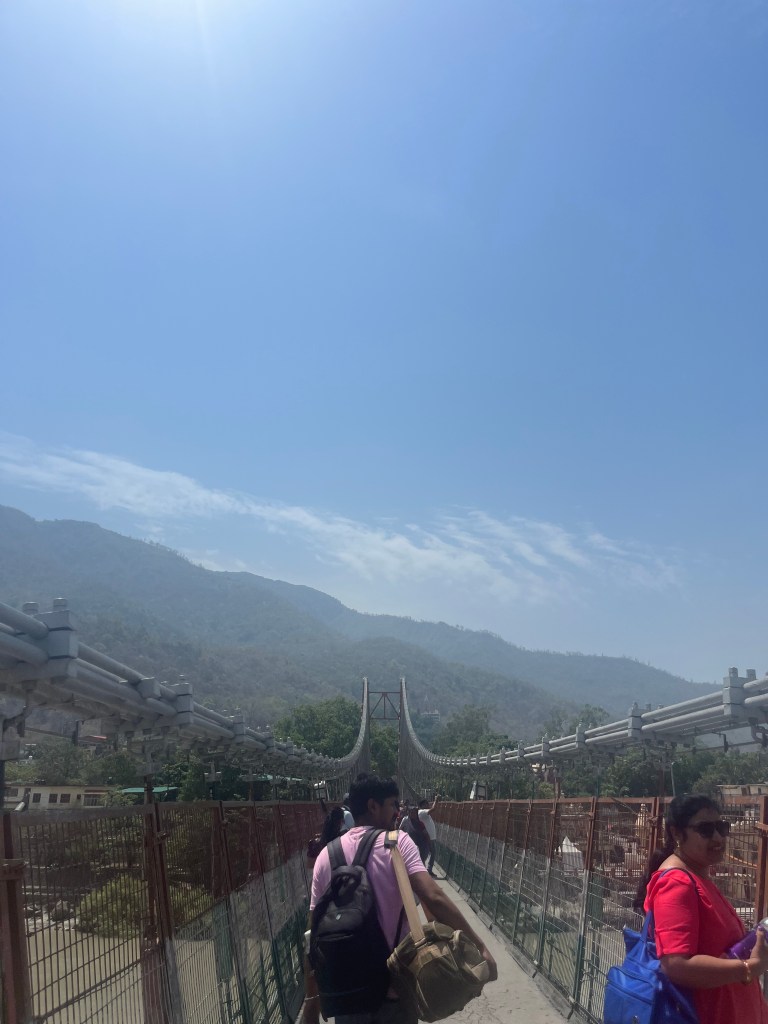
Crossing Ram Jhula
From this side of the river I started my walk to the Beatles Ashram, which felt like it lasted forever in the heat. However, it was completely worth the trek.
Chaurasi Kuit, better known as the Beatles Ashram, was built by Maharishi Mahesh, a yogi master credited for developing Transcendental Meditation. Since I know very little about yoga, I’m taking a direct quote from Wikipedia (yikes, but at least give me credit for citing the source!) that describes it: a form of silent meditation, “the TM technique involves the silent repetition of a mantra or sound, and is practiced for 15-20 minutes twice per day.” Maharishi Mahesh recruited and taught millions of people to the practice and created a TM teacher training program, all resulting in many worldwide organizations that promote the practice for its positive effects on health and wellbeing.
…Now, imagine doing all of that just for this impressive 14 acre land to eventually only be popular because The Beatles visited the ashram in 1968. Spending eight weeks in this ashram in Rishikesh, the members of The Beatles used this time to find their “inner peace”, which resulted in their creation of dozens of songs (much of what is included in their White Album). Interestingly enough, it’s probably better that it’s known most because of The Beatles visit. Shortly after their arrival, they discovered that there were several sexual assault and misconduct allegations against Maharisi. This article writes an interesting perspective on this (yikes!!).
In 1981, Maharishi Mahesh abandoned the ashram and it was poorly maintained throughout the years. In 2015, it reopened as a tourist attraction.
The several buildings, that of which includes a temple, residences, 83 meditation huts, a library, kitchen, even a post office, etc., are quite dilapidated nowadays. Though in my opinion, it doesn’t make the land any less interesting. Many of these former buildings are covered in murals, commissioned by authorities back in 2016. Additionally, the land sits on a cliff that overlooks the Ganges.
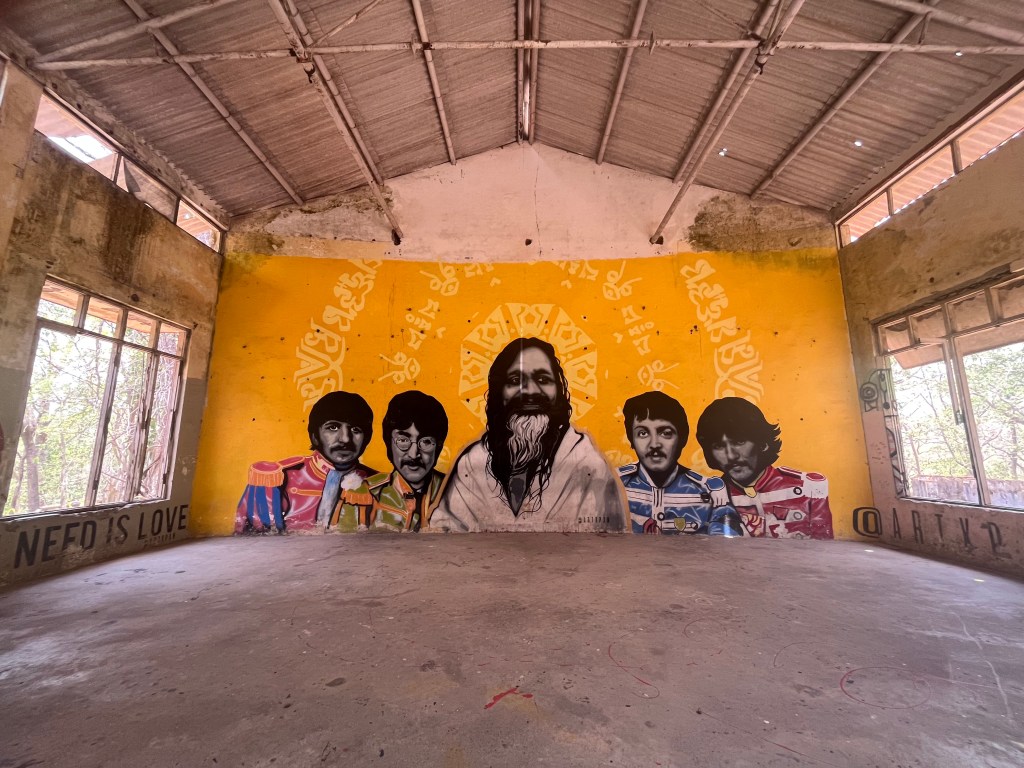
Murals inside one of the buildings, The Beatles and Maharishi Mahesh

A meditation hut
I got lucky. Even on a Saturday afternoon, the attraction was nearly vacant. It felt a little spooky! I spent a couple of hours here exploring the buildings, murals, and taking a rest to observe the view of the river.
I find these kinds of attractions fascinating for several different reasons. It’s really interesting to see how the land has deviated from its original intent, creating something completely new.
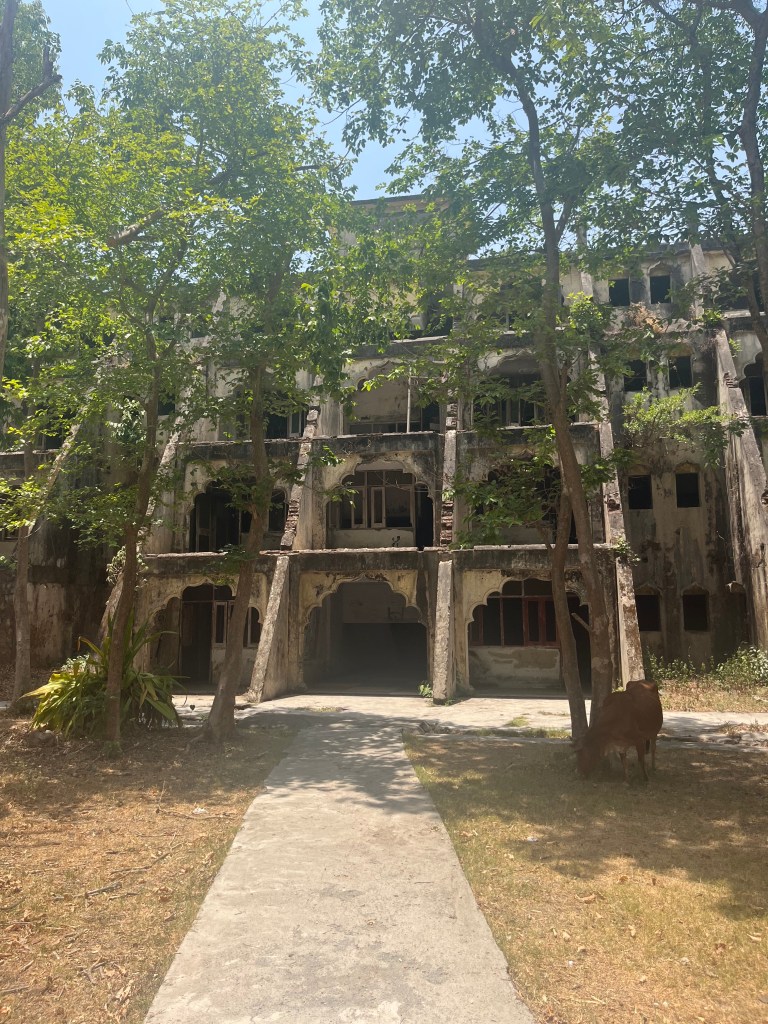
An abandoned structure and a cow
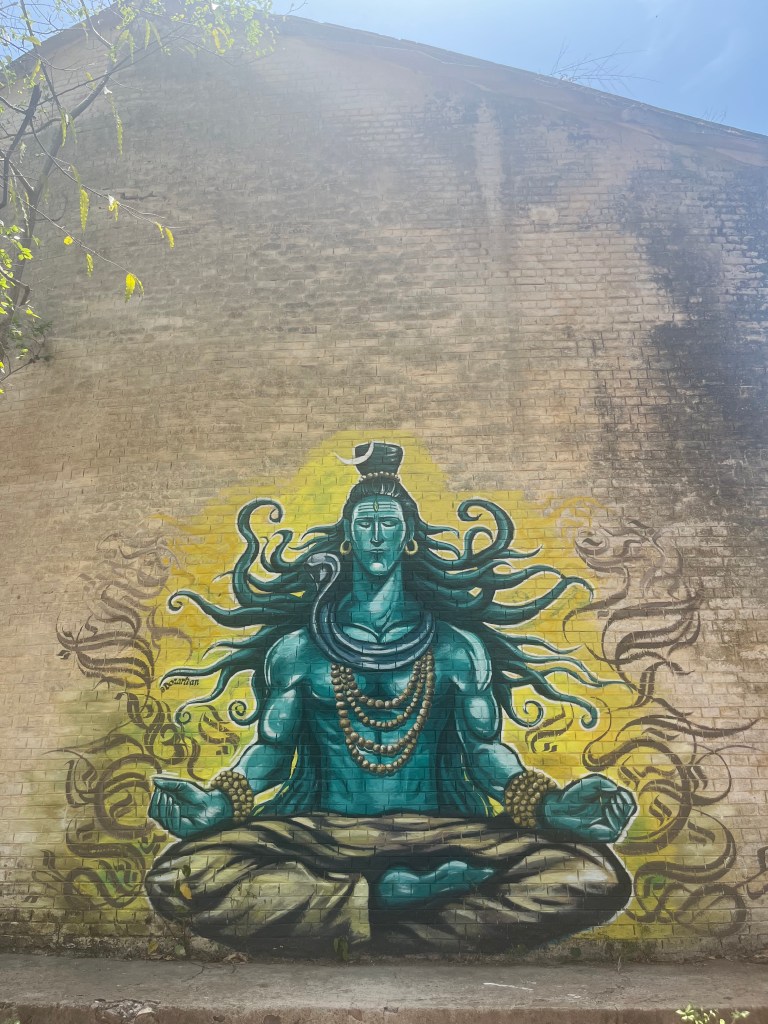
Another mural
I survived the trek back to my hostel to take shelter and recover from the sun. In the evening, I made my way back across Ram Jhula to see the Ganga Aarti at the Parmarth Niketan Ashram Ghat (I describe seeing the Ganga Aarti in Varanasi in part 1). I arrived just in time, securing the perfect spot!
This time around, the Aarti was a bit easier to follow since I’d seen it once before. The crowd was also a lot calmer and a bit smaller than in Varanasi. The young boy sitting next to me provided me with ample entertainment as well, asking all sorts of questions (yes, even if I was married) and practicing his conversational English with me.

Beginning of the Ganga Aarti at the Parmarth Niketan Ghat
Another long day in the sun, I had dinner and went to sleep early.
Three days left in my two-week backpacking trip, I woke up realizing my energy level and social battery was slowly depleting. In order to conserve this, my second day in Rishikesh was a lot slower (and involved a bit more shade).
After a quick breakfast, I spent the morning walking along the ghats of the Ganges visiting several different shops (yes, I do this every place I go and yes, most of these shops sell the same thing). Soon after, I sat along the river to take in the view. Interestingly enough, the Ganges’ current in Rishikesh is quite strong, making it a very popular spot to do white-water rafting. Across from me was Trayambakeshwar Temple, a thirteen-story high Hindu temple. I couldn’t figure out how to get to it, since the Lakshman Jhula (bridge) was closed due to renovations, but I’m not sure I had it in me to walk up thirteen flights of stairs anyways. I took a lot of silly self-timer photos of me standing in front of it though.
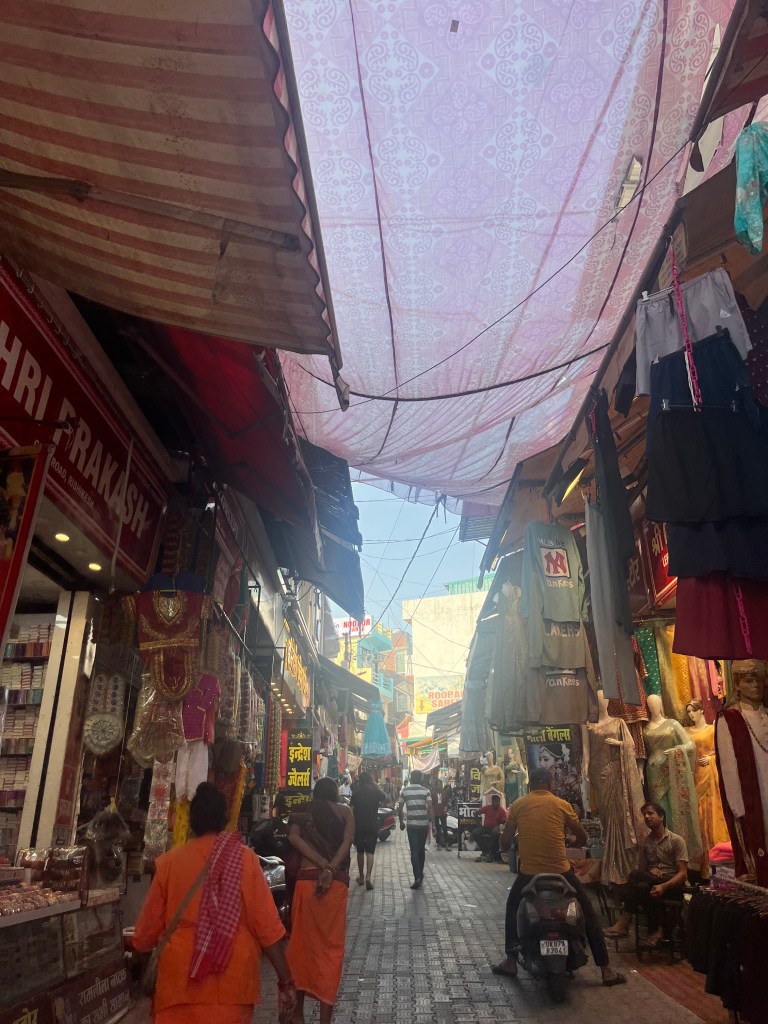
Market street view

Lakshman Jhula
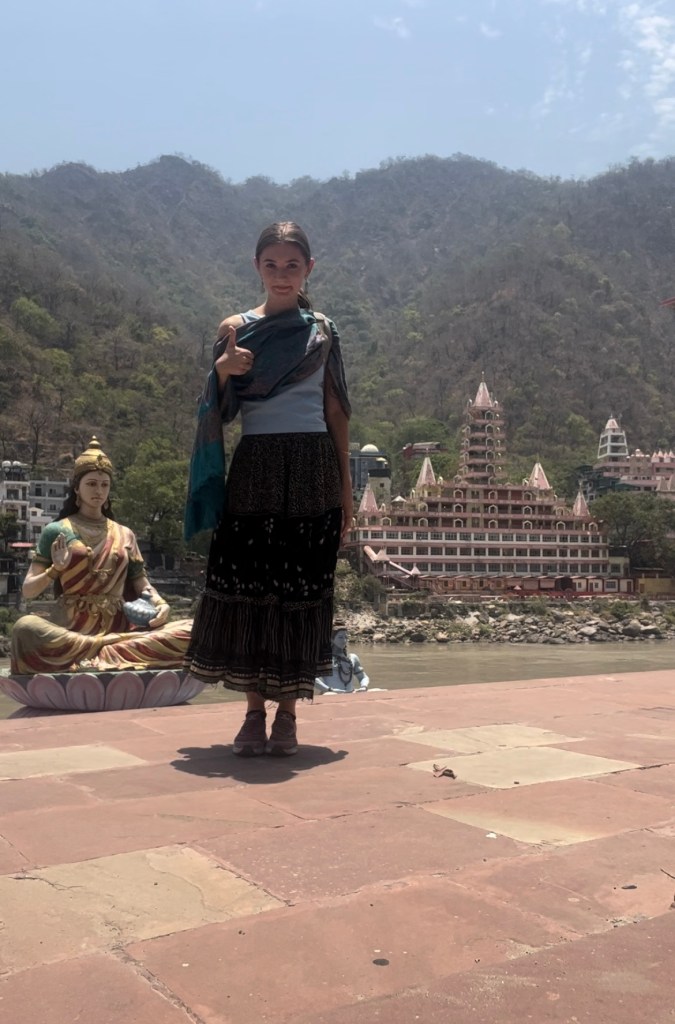
Me in front of Trayambakeshwar Temple
Leaning into the tourist vibes, I grabbed lunch at the famous Beatles Cafe. The food was nothing special, but the view of the river made up for it.
My big adventure of the day was getting to the Triveni Ghat, the most famous place in Rishikesh to observe the Ganga Aarti. And an adventure this was!
My run-in with the first auto rickshaw driver in Rishikesh made me a bit suspicious of going anywhere in an auto, so much so that I had asked the employee at my hostel if he thought it would be difficult to catch a ride to the Triveni Ghat. Even after reassuring me that it’d be no issue, I remained skeptical.
…And I had every reason to be. When I arrived at the auto stand and showed some drivers where I needed to go (which was about 30 – 40 minutes due to traffic) they all shook their heads. Apparently no autos would take me, but someone on a scooter would. A guy, who definitely couldn’t have been older than 20, offered to take me on his scooter. After going back and forth with the drivers asking are you lying to me? I took the chance and hopped on.
Once on the scooter, it was clear that the auto drivers weren’t lying and it definitely made more sense to take a scooter. Lucky for me, the guy who dropped me off offered to pick me up once I was done. I was so glad that he did because once I got to the Ghat, I realized it would’ve been such a hassle to return and it was very possible I would have been a bit stranded.
This was the most interesting and fun Aarti I had seen. I was so close to the pandits and the river that I not only could clearly see the ritual, but I even got to participate. I was able to put my hand on the flame when they passed around the lantern and threw some flowers into the river. I had to be prompted by the people around me to know what to do next, but it was very nice. After the ceremony, the crowd gathered on a dance floor (seriously) and danced around to some music.

Ganga Aarti ceremony on the Triveni Ghat
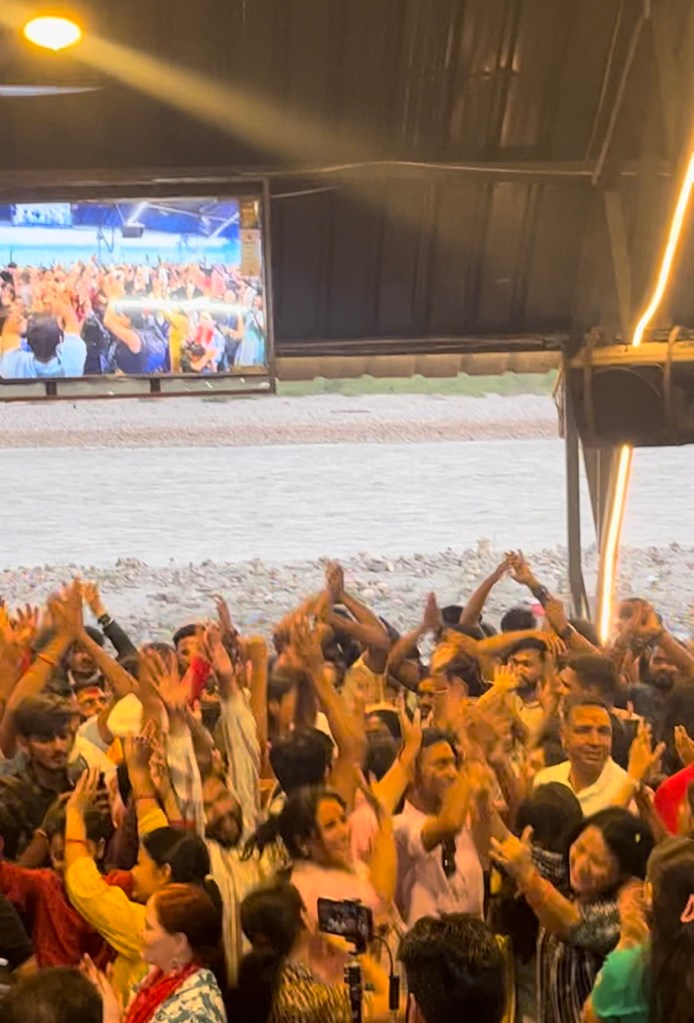
Dance party after Ganga Aarti
The guy who dropped me off eventually came back to get me and, because of the traffic, it was a longer ride back to the hostel. When we would stop for a while in dead traffic, he began to ask me all sorts of questions. My favorite one being where is your husband and son? This was the first time someone has ever just assumed I had children, which was equally humorous as it was nearly hurtful. I told him all about my (fake) fiance and my impending wedding ceremony. After a bit more conversation, I reached my hostel all in one piece. Phew!
In all honesty, I had some reservations about visiting Rishikesh. I was worried it would be a bit overcrowded (from foreign yogis) and that I just wouldn’t vibe with it. Admittedly, and to my surprise, I now totally understand the appeal. In comparison to Varanasi, Rishikesh was my favorite out of the two. Though definitely more touristy, I found it to be easier to navigate and even more spiritually alive. Which does make me question some of its authenticity and whether or not it was because it is so well-loved by foreigners. Food for thought. I will say that Varanasi is the place to see if you’re really trying to experience India for all that it is: good, bad, interesting, overwhelming, full of culture, etc.
A Brief Overview of Amritsar
Amritsar is located in the northern part of Punjab, just 15 km east of the Pakistan border. It’s known most for its tourism, hospitality, and handicrafts but is also a destination for Sikhs from around the world as a pilgrimage location.
Drinking Beer in Amritsar
My travel day to Amritsar from Rishikesh was quite painless, compared to my previous travels, since I was just catching a quick flight.
Up until Amritsar, my accommodations through my previous cities were all shared hostel dorm rooms. This is a great way to stay on budget (and when it’s tourist season – a great way to make friends!) but I was starting to get a bit tired of climbing up a ladder to my top bunk. I was excited to reach Amritsar because I was staying in a homestay with my own private room!
A homestay is sort of a combination between an AirBnB/Bed and Breakfast. This particular homestay in Amritsar was a private room in a family home. The hosts included a husband, wife, their two daughters, and the husband’s parents. I made the decision to do this because the husband is also a local tour guide and it made it easier for me to get around the city.
When I landed in Amritsar, the host of the homestay picked me up from the airport. The first couple minutes of the car ride consisted of the typical questions. Where are you from? How long have you been in India? My responses to these questions were quite short, mostly because I was tired but also because at this point in my trip I was getting a little bored of reintroducing myself over and over again. We got onto talking about food preferences when he casually asked if I drink alcohol. “Sometimes. Mostly wine. I like gin, too. Not really beer but I’ll drink it sometimes.” Unsurprisingly, because Indians are known for their hospitality, he then asked if he can buy me a beer. “Only if you’ll drink one with me,” I said jokingly. Suddenly he pulled off to the side of the road, disappeared for a few minutes, and hopped back into the car with two bottles of Kingfisher. “I don’t normally drink but…” He cracked open his beer. Cheers. And then we were back on the road on our way to the homestay while every few minutes he took a sip of his beer. It was certainly the most odd airport transfer I’ve ever had.
The next morning, I met his wife and ate breakfast with the two of them while he explained the plan for the day. Even he knew that we wouldn’t be able to last long outside before really feeling the effects of the summer heat.
He drove me into the city and we began our walking tour. Our first stop was Jallianwala Bagh, a historic garden and memorial just a ways away from the Golden Temple. In 1919, thousands of unarmed Indians gathered at this site to peacefully protest a recently enacted (by British powers) repressive law. British soldiers opened-fired on the crowd, killing hundreds of civilians and injuring many more.
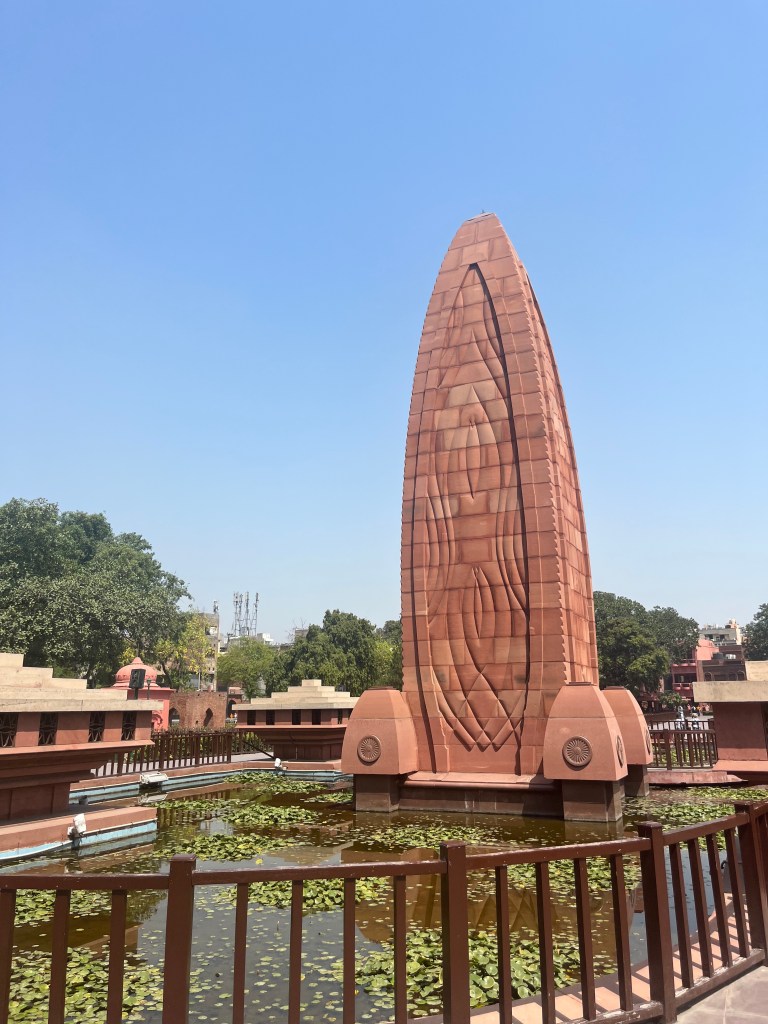
Structure at Jallianwala Bagh

Bullet holes at Jallianwala Bagh
Afterwards, we began our walk to the Golden Temple. This temple is a spiritually significant site for Sikhs, though is open for all kinds of people and religions, and draws in thousands of people a day to see its beauty. The pool of water that surrounds this building is viewed as holy, so many people will take a dip to cleanse their sins.
The temple itself is quite beautiful and certainly an impressive structure. I chose not to enter it, however.
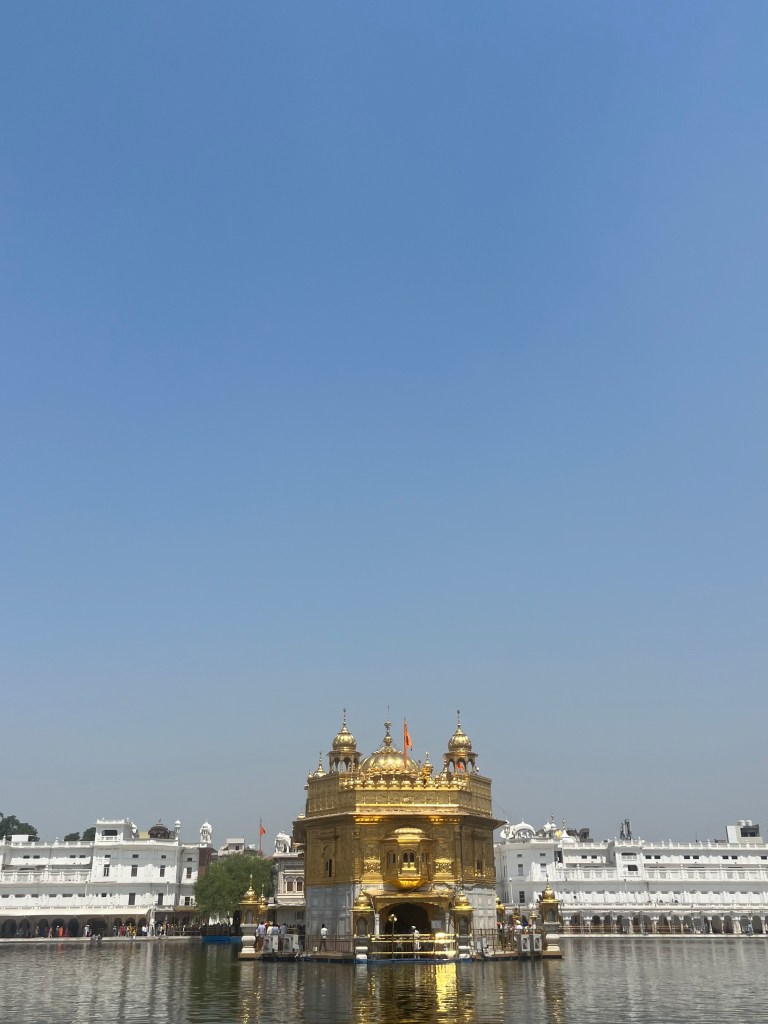
Golden Temple
The complex that surrounds the Golden Temple is large and is home to many different things, one of which includes a Sikh-run kitchen that offers free vegetarian meals to all its visitors. My tour guide/host took me to see the kitchen and it was remarkable. It was a huge room with easily over fifty people working at different stations; women kneading the chapati dough, men cooking over the fire, others washing the dishes. The “cafeteria” was lined with over a hundred people at once being served and eating the meal.
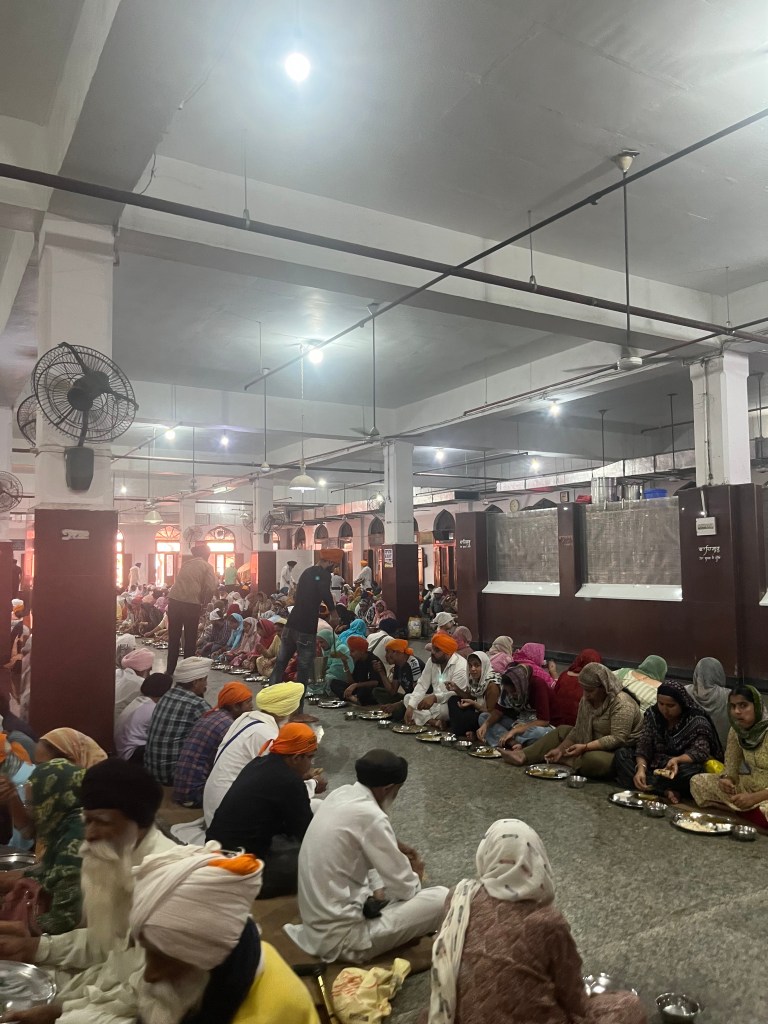
People eating meals from the free kitchen
Once we had completed the tour of the Golden Temple, we did a bit of walking through the markets before I decided I was getting too hot. We returned to the homestay and I ate lunch.
In the evening, my host drove me to the Attari-Wagah border (India-Pakistan border) to see the Beating Retreat Ceremony.
This ceremony occurs every evening before sunset and is an incredibly lively event. The loud cheers from the spectators on both sides of the border echo. I can really only describe this ritual as a well-choreographed battle reenactment. There was a lot of roaring from the soldiers, some defense poses, and intimidation tactics. From where I was sitting, I could see the Pakistani soldiers perform their parts. This article details it so much better than I can and it includes even better photographs.
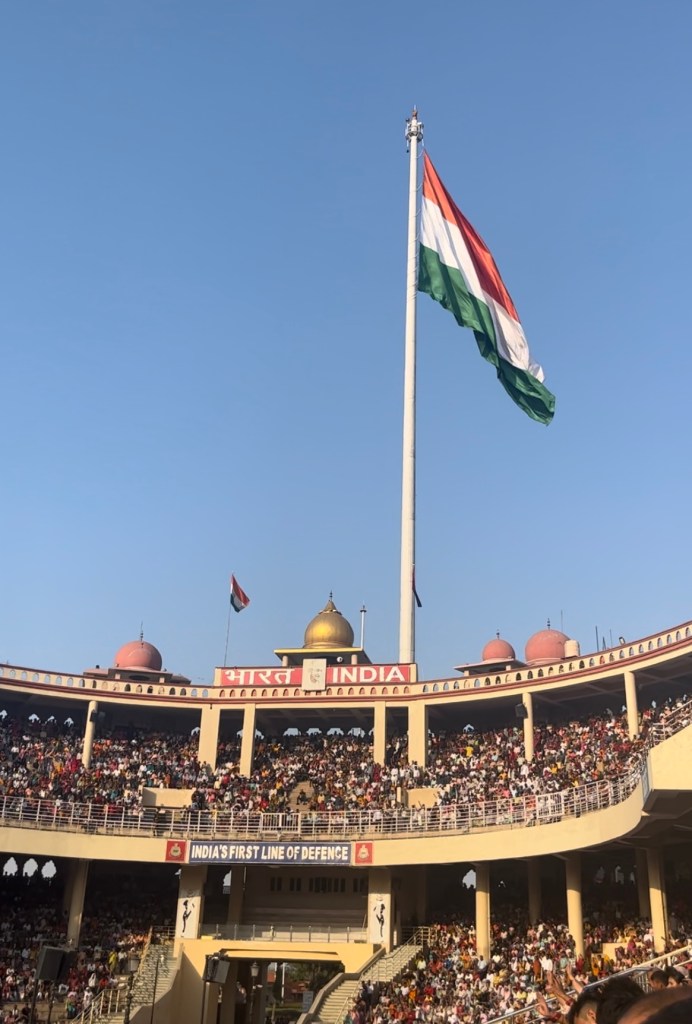
India’s stadium at the border procession
And just like that, my one day in Amritsar was complete. Soon after the flags were taken down at the border, I was on my way back to the homestay to pack my oversized backpack and head back to Mangalore the next morning.
__
If you told me a year ago that I’d solo travel through India (and survive it), I probably wouldn’t believe you. Doing all these adventures and reminiscing on it as I wrote these stories has put into perspective just how much I have changed and how India has changed me. I am a lot more brave than I was a year ago. More confident, patient, empathetic…less scared of what I don’t know. I can’t put into words how grateful I am for it.
In the coming weeks, I’ll have one last blog post that puts all these stories, emotions, and experiences into one final thought.
Disclaimer: This blog is not an official site of the Fulbright Program or the U.S. Department of State. The views expressed on this site are entirely those of its author and do not represent the views of the Fulbright Program, the U.S. Department of State, or any of its partner organizations.


 Roaring Through My Twenties
Leave a reply to pmjohannessen4 Cancel reply